A Rainy-Day Plan for a Community Sports Open Day
Plan a rainy-day community sports open day with clear arrival details, indoor and outdoor options, and an easy route for visitors to explore at their pace.
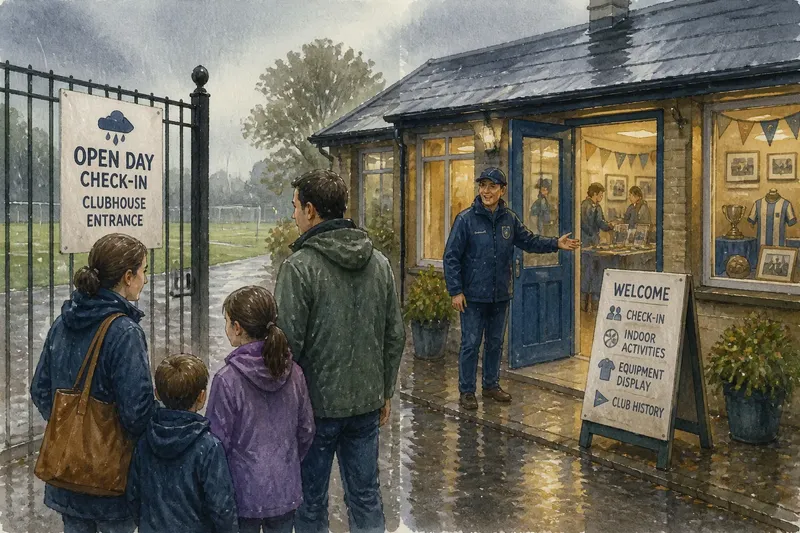
Rain taps on the clubhouse windows while a family pauses at the gate, unsure whether the open day is still happening. A good rainy-day plan for a community sports open day answers that question before visitors leave home, then gives them a clear first move when they arrive. The aim is not to reproduce a perfect-weather event indoors. It is to keep the welcome, the sport and the club’s traditions visible while adapting safely to the conditions.
Use the checklist below as a working plan, not a promise that every activity can continue in every kind of weather. Assign one person to check conditions and make decisions; give that person a named backup. For field, court, pavilion and equipment restrictions, follow the facility’s rules, the relevant sport governing body’s guidance and local weather or emergency advice. If conditions make an activity unsafe, cancel or relocate it rather than trying to make it work.
Why do visitors arrive without knowing what is open?
When the forecast changes, people often hear conflicting updates: one post says “on,” another mentions a wet-weather move, and a sign at the entrance has not been changed. The cause is usually not a lack of effort; it is that no one owns the final message or the time when it will be posted.
Choose a decision time that leaves visitors a reasonable chance to see the update before traveling. Name the person who makes the call, and name the backup. Agree in advance which conditions trigger a change, such as a closed field, an unusable outdoor court, or a facility instruction to suspend play. Avoid vague language such as “weather permitting” without saying where the current decision will appear.
Use one primary channel, such as the club’s website or social media page, and repeat the same update on the other channels the club already uses. Include:
- Whether the open day is going ahead, changing location, or canceled.
- Which activities and areas are open, paused, or moved inside.
- The entrance visitors should use and where to check in.
- Any change to parking, public transit access, or accessible entry.
- When the next update will appear if the decision is still pending.
Keep the language direct. “The field activities are paused; the clubhouse welcome and equipment display are open” tells visitors more than “wet-weather arrangements apply.” If the club cannot confirm a safe option, say so plainly and give the next update time rather than inviting people to guess.
What should the wet-weather checklist cover?
A checklist helps volunteers make the same decisions at the gate, inside the building and online. Write each item as a check followed by a decision, so it is useful under pressure.
- Field and court status: Check the facility’s current direction and the surface condition. If an area is closed or unsuitable, mark it unavailable and remove its activity from the schedule.
- Indoor capacity and layout: Check which rooms can be used and how people can move through them. If a room cannot comfortably support the planned activity and visitors, use it for a smaller display or remove that activity.
- Entry and accessible route: Check which entrance is open, whether the approach is clear, and where visitors can ask for help. If the usual route is affected, publish the alternative and place a volunteer at the decision point.
- Wet clothing and belongings: Check where coats, umbrellas and muddy footwear can be kept without blocking an exit or route. If there is no suitable holding area, tell visitors what to expect and keep walkways clear.
- Equipment and demonstrations: Check that each item is suitable for the chosen space and activity. If a demonstration needs a surface or clearance the room does not provide, replace it with a talk, display or short explanation.
- Signs and updates: Check that the entrance, check-in point and activity signs match the latest announcement. If they differ, correct them before directing arrivals onward.
- Volunteer roles: Check that someone is assigned to check-in, indoor directions and the weather update. If a role is uncovered, simplify the program rather than expecting one person to cover several busy points.
Keep the checklist where the event lead and volunteers can reach it, such as a printed copy at the check-in desk and a shared digital copy for the planning team. Update the same document when a decision changes. Separate copies can quickly drift out of agreement.
Why does the arrival point become confusing?
Visitors tend to follow their usual route, even if rain has shifted check-in from the field tent to a side entrance. Confusion grows when the first sign appears after the fork in the path, or when a volunteer is stationed inside where newcomers cannot see them.
Put the first direction where a visitor must choose: at the parking entrance, gate or path split. Use large, plain wording such as “Open day check-in: clubhouse entrance.” Then repeat the direction at the door. If the route is different from the usual one, mark the turn itself rather than assuming people will infer it from a map.
At check-in, use a simple greeting and a short explanation of the available options. A printed site map can show the welcome desk, indoor activities, any open outdoor area, toilets and the exit. Avoid filling it with every club detail. A visitor should be able to glance at it and decide where to go next.
For example, say a family arrives to find the field sessions paused and the clubhouse entrance moved to a side door. The event lead posts that change online, a sign at the gate points to the side door, and a volunteer there explains that the indoor equipment display is open while the field remains closed. The expected observable result is that the family can choose whether to enter, rather than wandering toward an unavailable activity.
How can indoor and outdoor options feel like one event?
A wet-weather plan can feel like a collection of leftovers if indoor activities have no connection to the sport or the club. Keep a few options that explain what members do and why the club gathers, even when visitors cannot try the usual activity.
Choose alternatives that suit the actual room and available volunteers. Depending on the club and its facilities, these might include:
- A short equipment display with a member explaining what each item is for.
- A rules or tactics conversation using a simple diagram or marked-up score sheet.
- A club-history table with photographs, pennants, programs or other items the club is comfortable sharing.
- A seated introduction to how a match or practice session is organized.
- A brief demonstration only if the room, equipment and activity allow it safely.
Keep an outdoor option only when the relevant area is open and the activity suits its condition. Make the alternative easy to understand: “If the field is open, watch a short skills demonstration; otherwise, see the equipment display in the pavilion.” Do not send visitors outside to discover that an activity has stopped. A volunteer should update the sign or announcement when the status changes.
Traditions can also travel indoors. A club song, welcome toast, team colors or end-of-season ritual may be part of how members recognize one another. Explain its place in the club and invite visitors to observe or join only if that invitation is appropriate. A tradition should help newcomers understand the gathering, not make them feel they have missed an unwritten rule.
How can visitors explore at their own pace?
Some visitors want to talk with a coach; others would rather look around quietly before deciding whether to join an activity. A fixed tour that starts every few minutes can leave both groups feeling hurried, especially when weather pushes everyone into a smaller space.
Offer a self-guided route with a small number of clearly marked stops. For instance, a visitor might move from check-in to a club display, then to a demonstration area and finally to a table where they can ask about future sessions. Give each stop a short sign that answers one useful question: What happens here? Who can I ask? Is this activity open now?
Make the route optional. A greeter can say, “You can follow the signs, stay here for a chat, or go straight to the activity that interests you.” That phrasing gives visitors permission to choose without forcing them to explain why. If the building is crowded, mark a clear route through the space and leave room near the entrance for people who need a moment to orient themselves.
What questions do visitors ask before setting out?
Should the open day still go ahead in rain?
That depends on the facility, the weather and the activities planned. Publish a clear go, change or cancel decision, and do not keep an activity running if the responsible facility or event lead considers conditions unsuitable.
What should visitors wear or bring?
Give practical, site-specific advice in the event update, such as bringing a raincoat or wearing footwear suitable for the stated route. Do not imply that visitors need specialist kit merely to look around.
How can a visitor ask for an accessible route?
List a contact method before the event and identify the accessible entrance or check-in point in the update. A volunteer at the first decision point can also direct visitors without requiring them to search the site.
What if someone arrives after the schedule changes?
Keep the entrance notice current and leave a volunteer or clear written update at check-in. Show which activities are still open and where to go next, rather than asking late arrivals to rely on an earlier online post.
How should the team handle a change during the day?
Rain can intensify, an outdoor area can close, or an indoor room can become too crowded. Decide who has authority to pause or move an activity, and make sure that person can reach the volunteers managing the entrance, activity areas and public updates.
When a change is needed, follow a simple order:
- Pause the affected activity and direct people away from the area if needed.
- Confirm the next available option with the event lead and facility contact.
- Tell the volunteers who speak with visitors, then change the signs and online update.
- Give visitors a specific alternative or explain that the activity has ended.
Keep the message consistent at every point. If an activity is canceled rather than moved, say that directly. Do not leave a sign pointing toward a closed area, and do not describe an uncertain reopening as a definite plan.
How can the open day keep its welcome in bad weather?
Visitors often remember whether they could work out where to go and whether someone answered a straightforward question. A warm welcome does not require a packed program. It requires a visible greeting, honest updates and alternatives that make sense for the space.
Before doors open, walk the visitor route from the approach to check-in and onward to the available activities. Check that signs agree, the first volunteer knows the current plan, and the route does not lead toward a closed area. Afterward, ask volunteers which questions they heard repeatedly and note where visitors hesitated. Use those observations to make the next rainy-day community sports open day easier to understand, while keeping the club’s traditions and character in view.